

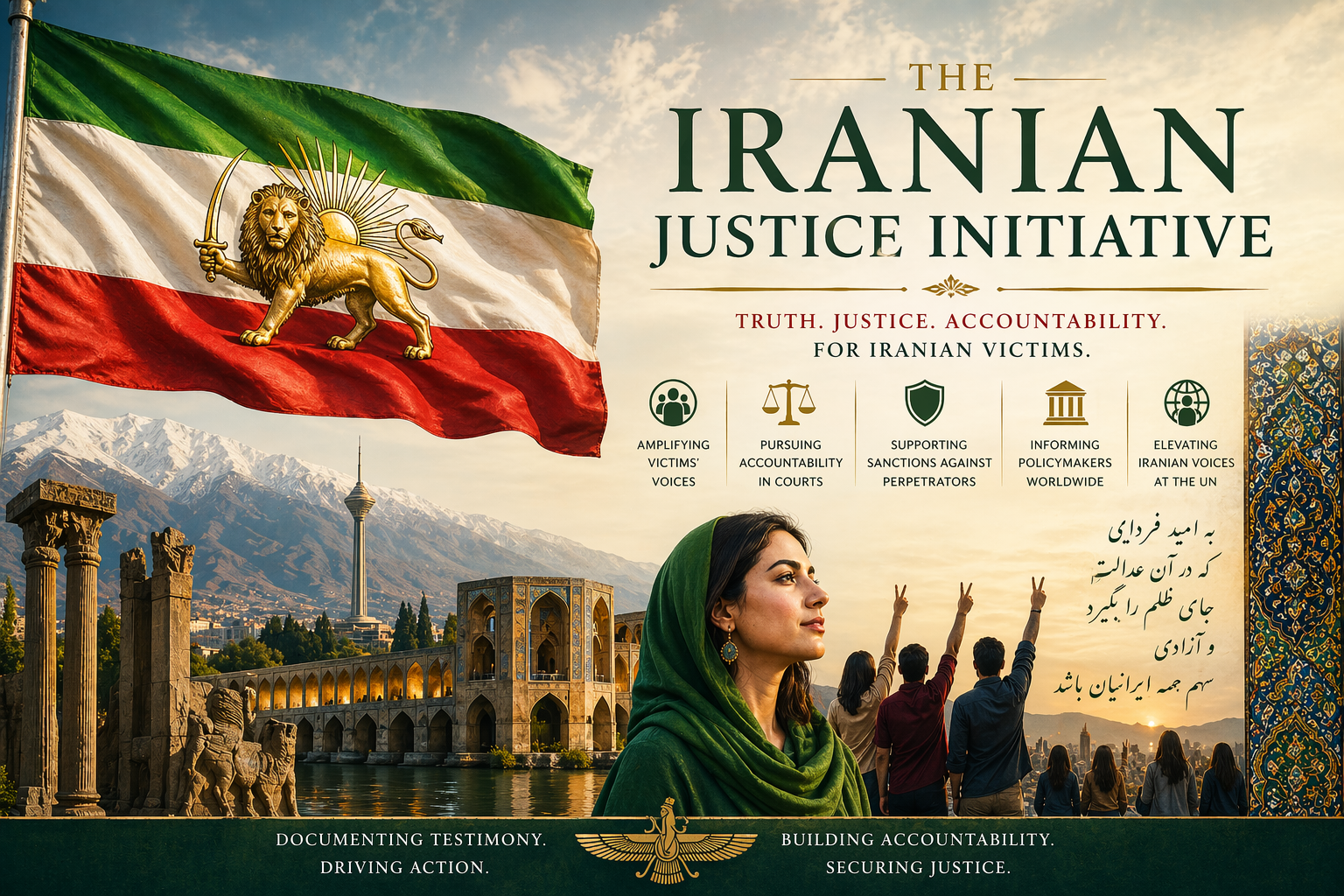
An international campaign for accountability, truth, and the voices of Iranian victims
What this is
The Iranian Justice Initiative is a new international effort to document, preserve, and act upon evidence of atrocities committed by individuals within the Iranian regime.
It is a structured, legally grounded programme designed to support accountability through evidence, law, and public scrutiny.
The starting point is simple: victims of the Iranian regime have testimony. Much of it has never been properly collected, protected, or used.
We intend to change that.
What we are doing
We are building a coordinated, multi-country effort to gather testimony from Iranian victims and witnesses in the diaspora, beginning in:
Germany
Ireland
Great Britain
The United States
Canada
This testimony will be:
Collected securely
Verified and documented
Translated where necessary
Reviewed by legal professionals
It will then form the foundation of a major public report, designed for use by:
Journalists
Legislators
NGOs
Legal practitioners
Prosecutorial authorities
This approach reflects a core principle: accountability begins with evidence.
What this leads to
The Initiative is structured to move from testimony to impact.
That means:
Legal accountability
Where evidence meets the relevant thresholds, it will support legal actions in jurisdictions that allow for prosecution under domestic or universal jurisdiction frameworks.
Sanctions pathways
Evidence dossiers will be prepared to support targeted sanctions against identified individuals under existing legal regimes.
Policy engagement
Findings will be briefed to policymakers in legislatures across Europe and North America, ensuring that decision-makers are working from documented evidence rather than assumption.
Public awareness
A focused media effort will ensure that these stories are seen and understood, rather than remaining confined to private testimony.
International platforms
We will work to ensure that Iranian victims are heard in international forums, including, where possible, the UN Human Rights Council.
Why this matters
Authoritarian regimes rely not only on coercion, but on silence and distance.
Victims are separated from the systems that might deliver justice.
Their testimony remains fragmented, uncollected, or unusable.
This initiative addresses that gap.
It is based on a simple proposition:
If evidence is properly gathered,
If it is legally structured,
If it is placed in front of institutions that can act,
then impunity becomes harder to sustain.
This is not about rhetoric. It is about closing the distance between crime and consequence.
How this is structured
The campaign operates across four integrated tracks:
1. Testimony Collection
Secure, ethical, multi-country evidence gathering from Iranian victims and witnesses.
2. Legal Analysis
Assessment of jurisdiction, evidentiary thresholds, and viable pathways for prosecution or sanctions.
3. Public Reporting
Production of a high-quality, evidence-based report designed for global media and policy use.
4. Policy and Institutional Engagement
Direct engagement with legislatures, NGOs, and international bodies to convert evidence into action.
This integrated model reflects a broader understanding:
information, law, and policy must operate together to produce results.
Funding and scale
This work is being built from the ground up.
Our initial target is:
£310,000 for the first 90 days
This funds:
Legal staff and review
Research and documentation
Testimony handling and verification
Translation and secure data management
Initial report production
Early-stage media outreach
The full first-year campaign budget is £2.13 million, supporting expansion across jurisdictions, deeper legal work, and sustained public engagement.
Who we are
The Iranian Justice Initiative is led by Stratos Council, a newly established 501(c)(3) organisation focused on:
Democratic resilience
Evidence-based public policy
Lawful accountability
Countering malign state activity
The organisation operates with a clear principle:
credibility depends on accuracy, legality, and transparency.
How you can help
If you believe that victims of state violence should have a pathway to justice, there are two ways to support this work.
1. Donate
Your support funds the practical infrastructure required to turn testimony into action.
2. Share
If you know individuals or organisations working on Iran, human rights, or legal accountability, sharing this initiative helps build the network required for impact.
A final point
This initiative does not promise outcomes it cannot control.
Legal processes are complex. Political systems are imperfect.
But without evidence, without structure, and without sustained effort, nothing happens at all.
This is an attempt to build that structure properly.
To collect what has been ignored.
To document what has been denied.
And, where possible, to help ensure that it leads somewhere.