

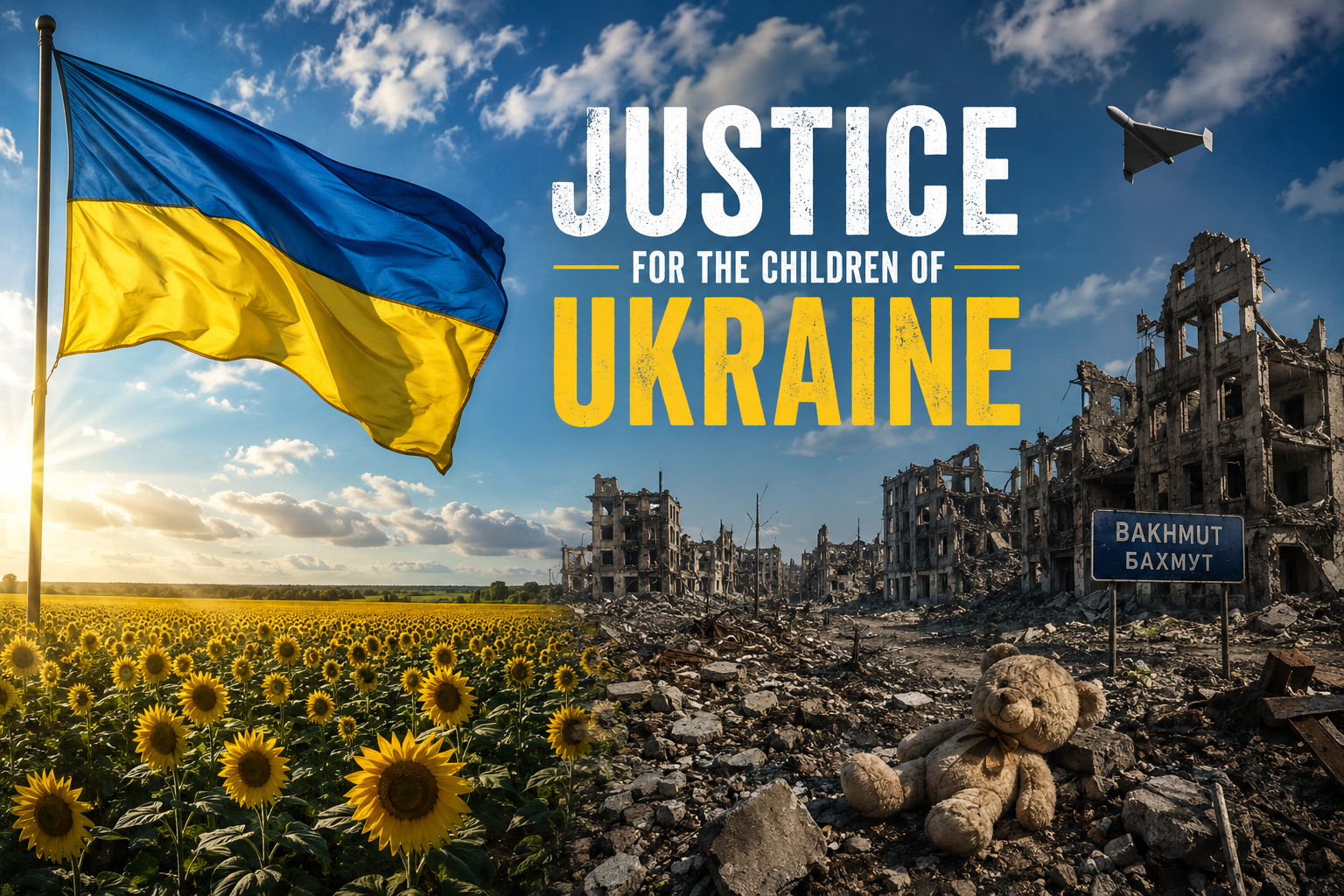
Ukrainian Children Justice Initiative
Recover the children. Restore their identities. Build cases.
Russia’s removal, transfer, and concealment of Ukrainian children is not an isolated wartime abuse. It is a structured system involving deportation, forcible transfer, identity alteration, naturalisation, institutional placement, and, in some cases, fostering or adoption inside Russia. The International Criminal Court issued arrest warrants in 2023 for Vladimir Putin and Maria Lvova-Belova over the alleged war crimes of unlawful deportation and unlawful transfer of Ukrainian children. In March 2026, the UN Commission of Inquiry concluded that Russian authorities committed the crimes against humanity of deportation and forcible transfer of children, and their enforced disappearance. The European Commission says that more than 20,500 Ukrainian children have been unlawfully deported or forcibly transferred, while just over 2,100 have been returned to Ukraine. 
The Ukrainian Children Justice Initiative exists to turn this evidence into action. We are building a structured, legally focused investigation that identifies not only senior officials and institutions, but named participants across the full chain of involvement, from intermediary bodies and facilitators to knowing foster or adoptive participants and the wider networks that enable concealment, identity change, and obstruction of return. Yale’s Humanitarian Research Lab has already documented a systematic Russian programme of coerced adoption and fostering, including naturalisation and listing children in Russian placement databases. Our work is designed to build cumulative, legally useful evidence on top of that public record. 
What makes this different
Much of the important work already done on Ukraine’s children has focused on tracing individual children, documenting transfer routes, exposing facilities, and identifying senior decision-makers. This initiative does something different. It is not an ad hoc OSINT exercise and not a one-off tracing effort. It is a structured investigation designed to build case-ready files over time.
We will identify named Russian participants across the full ecosystem of involvement: officials, intermediary institutions, facilitators, civil-society actors, and, where evidence supports it, foster or adoptive participants who knowingly took part in unlawful transfer, concealment, naturalisation, or retention. We will also use Russian social media platforms and the wider Runet to map how these practices are discussed, justified, normalised, and socially embedded.
In other words, this project will show not only how the machinery works, but who enables it, who participates in it, and how parts of Russian society help reproduce and legitimise it.
What we investigate
We investigate the full chain of transfer and concealment: the removal of children from occupied territory, transport routes, camps and institutions, changes to names and civil status, Russian citizenship grants, foster and adoption pathways, public and private facilitators, and the networks that obstruct return.
We also investigate the surrounding social ecosystem. That includes online communities, Russian regional and municipal actors, charities, patriotic organisations, media narratives, and civil-society intermediaries that help normalise, publicise, justify, or conceal the programme. Yale’s published findings on adoption databases, Russian-family placements, and the systematic nature of the programme show why a whole-system approach is necessary. 
What we do
We build child-by-child evidence files.
We preserve testimony from parents, relatives, guardians, returned children, social workers, and witnesses.
We map perpetrator and facilitator networks.
We identify the officials, institutions, and civilian enablers involved in deportation, transfer, identity alteration, fostering, adoption, and concealment.
We produce legally usable dossiers.
Our outputs are designed for prosecutors, sanctions teams, regulators, parliaments, and international institutions.
We support accountability across multiple routes.
That includes criminal referrals, sanctions submissions, policy briefings, and compensation pathways. The Council of Europe’s Register of Damage has opened a specific claims category for the forcible transfer or deportation of children, creating an additional route for documentation and redress. 
We engage policymakers and the public.
The European Union has made the return of unlawfully taken Ukrainian children a standing priority, and our work is designed to support that effort with disciplined, evidence-led analysis. 
Our legal approach
This initiative is built around accountability, not symbolism. We focus on legally viable categories: unlawful deportation, unlawful transfer, enforced disappearance, obstruction of repatriation, identity erasure, falsification of records, aiding and abetting, and knowing participation in unlawful custody or adoption systems.
We are careful in how we define responsibility. Not every adult who came into contact with a transferred child will have the same degree of knowledge or liability. Our standard is evidence. We will prioritise cases where there is credible indication of knowing involvement in unlawful transfer, concealment, identity change, obstructive retention, or participation in systems built on those acts.
Why this matters now
The current public record already establishes a grave legal and moral threshold. The ICC has acted. The UN Commission of Inquiry has concluded that Russian authorities committed crimes against humanity against Ukrainian children. European institutions have established return and claims mechanisms. What is still missing, in many cases, is a systematic bridge between public documentation and prosecutable, cumulative evidence. 
That is the gap this initiative is designed to close.
How you can help
If you are a parent, relative, guardian, witness, or professional with information relevant to a child’s transfer, placement, identity alteration, or current whereabouts, we want to hear from you.
If you are a lawyer, investigator, researcher, child-protection specialist, or policymaker working in this field, we want to build with you.
If you want to support the work, your donation strengthens a permanent structure for child recovery, evidence preservation, and accountability.